
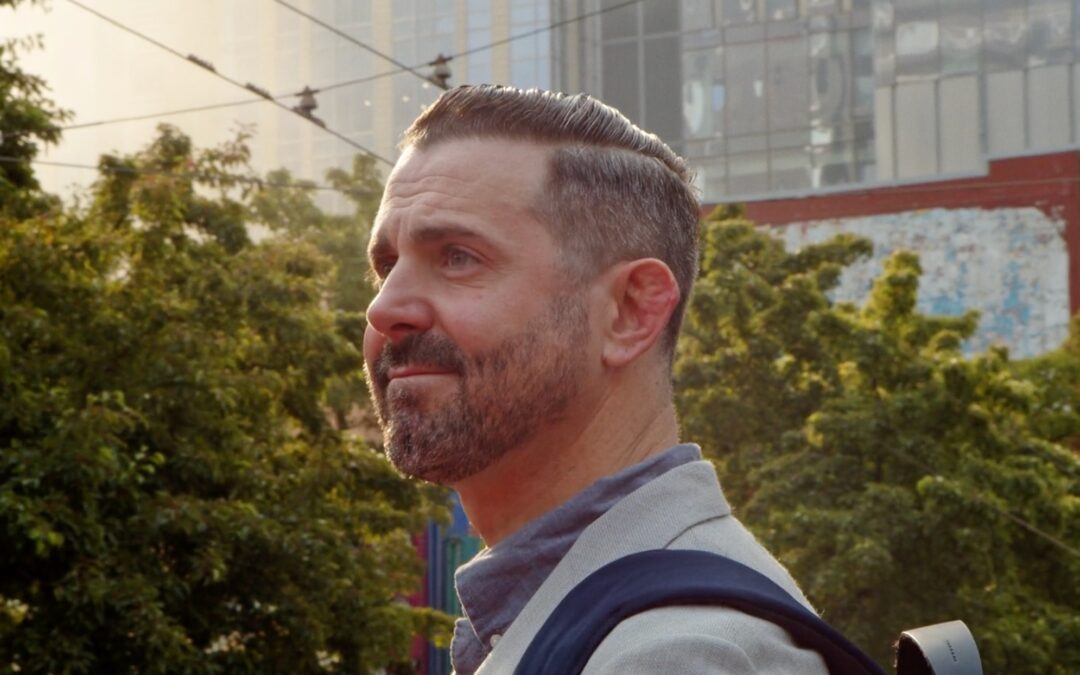
Marc Berger lived in Nebraska, China and New York until he finally he arrived in Seattle in 2013, the cross-country move from Brooklyn another milestone in his journey to the Partner team at DH. “There has been nothing but learning” along the way, Marc says.
He’s still learning, even as he helps lead the shared work in Seattle and beyond to keep moving forward.
“We’re not in the business of convincing people of something they don’t believe in,” says Marc, who became a co-owner of our social impact agency over the summer. “We’re about working with companies and leaders that are making people’s lives better.”
Marc reflects on his journey to Seattle, where he’s built a life, a career and a deep connection to community. Now a Partner at the agency, he talks about the passion for storytelling that drives his work in communications and social impact. He also talks about navigating uncertainty and helping leaders create meaningful change.
Coming to work every day in the center of downtown Seattle never gets old.
I moved to Seattle from Brooklyn in 2013, and it was a very different place.
I’d never been here before.
In a lot of ways, it’s like a small town.
It’s a lot closer to the place where I grew up in Nebraska than to New York.
Nebraska to New York, a stop in China, ultimately Seattle.
There has been nothing but learning throughout that process, every step of the process.
That learning is going to continue in the future, and that’s the work of communications.
I’ve been here for over a decade at this point.
I feel like I can claim some bona fides a little bit.
It’s been an incredible experience to become a part of this community, to raise a family here, becoming connected to my home.
I thought I wanted to be a professor.
My father’s a professor.
I was sure that’s what I wanted to do, and two days into graduate school, I realized this was definitely not the right move.
So I finished with a master’s and worked in the field that I studied for a while.
I studied Chinese foreign policy.
Coming to Seattle and starting to work in communications was a totally new experience for me.
We know that bold leaders are making bold changes in Seattle.
And we also know that Seattle is on the global stage.
It’s incredibly inspiring to be a tiny piece of some of the change and some of the impact and some of the storytelling that we do here.
I’m thrilled to join the Partner team and to become an owner of the agency.
The Partners who have run this company for the past 30 years, nearly, have built an incredible foundation, have built an incredible culture, and have stayed true to their values.
We’re not in the business of selling widgets.
We’re not in the business of convincing people of something they don’t believe in.
We’re about working with companies and leaders that are making people’s lives better, making people’s lives healthier, making people’s lives more equitable, building consensus, building coalition, building community around those causes.
It’s hard right now.
There’s no question.
And especially earlier this year, I think we all felt a sense of confusion, a sense of paralysis.
Our clients certainly did.
We as a company were trying to figure out what our agenda was.
What are we advocating for?
Where can we have the greatest impact?
Where can we make a difference?
We started to realize that people embraced the fact that we didn’t have all the answers, that we didn’t know exactly what was going to happen in this moment or where we were going to be in a year.
But in those moments of accepting that we don’t have answers, we can find some comfort and some energy around taking action.
We had a lot of clients, a lot of partners who continued to invest in big, bold vision and continued to want to take action to create the future that we wanted, rather than accepting one that we didn’t.
That’s the work of social impact.
It’s learning about what we don’t know, about who we aren’t connecting with, about how we can best connect with them, and how we can move big ideas forward.
None of us have those answers today, and we certainly don’t have those answers as to how we’re going to do that in five years.
We’ve got to learn along the way.
Sounds great.
Thanks, Dean.