
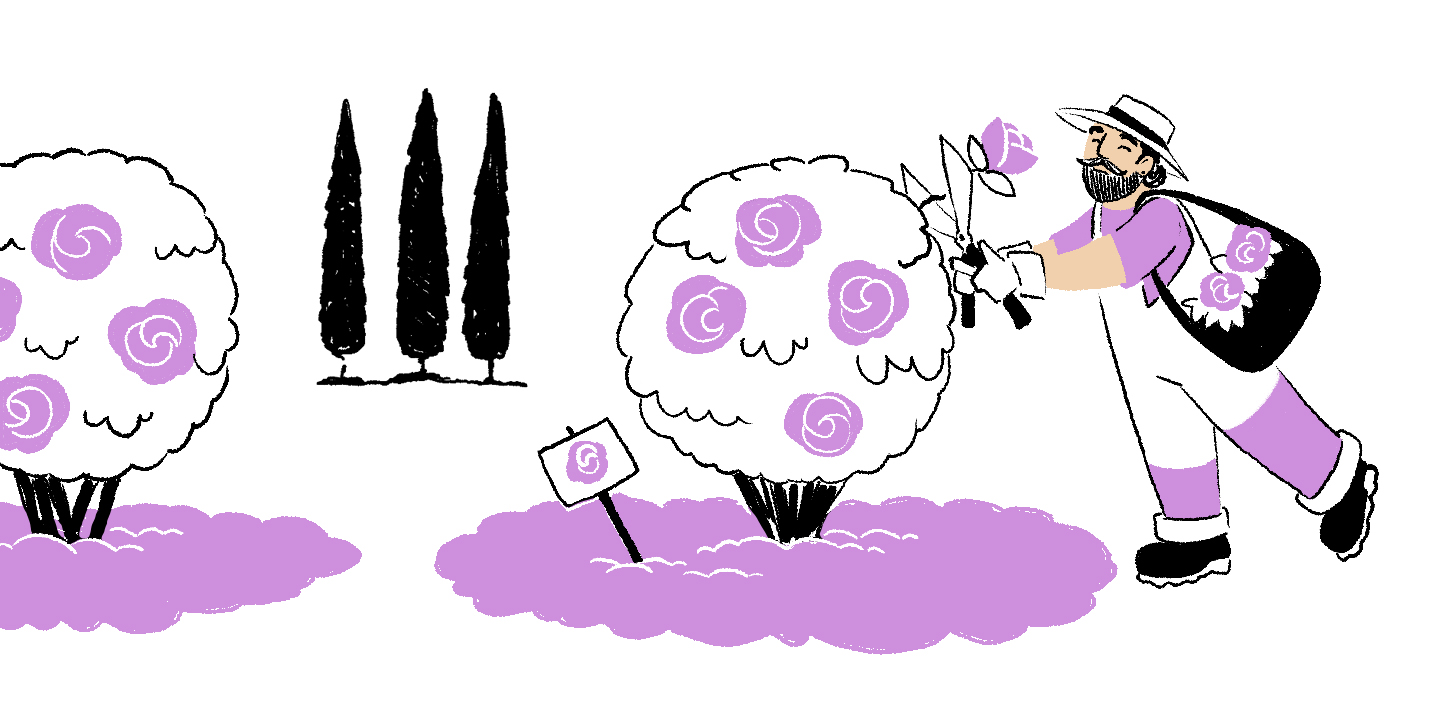
Great writing often means pruning: cutting unnecessary words so the core of your message shines. In marketing and communications, that means removing clutter to make it easier for your audience to understand and act.

By Nathan Weinbender
DH Senior Copywriter and Content Developer
There is widespread alignment around the implementation of more effective communication efforts, which can further optimize comprehension across sectors.
Got that? No? Let me rephrase.
Everyone agrees: Language that is plain and direct is easier to understand.
Better, right? That’s plain language in action. It’s approachable, accessible and equitable. It’s also more fun to read. To define plain language, the Center for Plain Language says it’s “communication your reader can understand immediately.”
Plain language doesn’t have to mean boring language. Think of it as the foundation for your writing, a blank canvas where you can add personality and style. One of the best observations I’ve read about plain language comes from this article: “No one has ever complained that a text was too easy to understand.”
No doubt you have encountered not plain language. Maybe you’ve been filling out a ballot and have been baffled by an initiative that wants to “impose a levy for the purpose of facilitating the procurement of infrastructural enhancements.” Wouldn’t it make your decision easier if it had said, “The city will collect taxes to fix roads and bridges”?
Or maybe you’ve gotten a memo from a client who wants you to “leverage internal capabilities to optimize cross-departmental efficiencies.” Translation: “Let’s work together to finish projects faster.”
The term “plain language” is used a lot these days: in business and marketing, public policy and tech. Organizations and state governments have also put plain language laws in place, and for good reason. This isn’t a passing fad. Language that is plain and direct helps people understand difficult topics — the terms on a rental lease, for instance, or their health care benefits.
Yes, even email.
We help clients write plain language messaging that still feels specific and memorable.
While working on a new brand for Catalynt, a Seattle-based manufacturing provider, we noticed many of their competitors wrote about their services in ways that were hard to understand. So we gave the Catalynt team examples of how they could describe their work in ways that were technical and professional as well as accessible.
We suggested that instead of saying something like this:
“The strong relationships we have developed with our capable partners enable us to bring successful solutions to our clients. Our network of international and domestic vendors enables us to efficiently source high-quality materials anywhere in the world.”
They should say something like this:
“We have great relationships with vendors around the world, which means we can get you what you need when you need it.”
But plain language doesn’t just apply to technical writing. We hold ourselves to plain language standards in everything we write – including this blog.
The next time you write a thank you note to a client, think about plain language before you hit send. If it reads like this:
“Your inclusion of our team at last week’s stakeholder convening was greatly appreciated and meaningfully advanced our collaborative pipeline.”
Try rewriting it like this:
“Thank you for inviting us to your networking event. It was great to connect, and we look forward to working with you!”
Tips and tricks.
Here are some easy ways to check your writing for plain language.
Read your writing out loud.With a colleague or just to yourself, reading your work out loud helps catch mistakes. Writing that looks good on the page can sound like a mess when you actually hear it. If a particular phrase is tripping you up or sounds overly complicated as you read it aloud, revise until it’s not.
Kick jargon to the curb.If your reader is copying and pasting words into an online dictionary or Googling acronyms, your writing hasn’t met plain language guidelines. This doesn’t just apply to big, multi-syllable words, either. Even basic words and phrases can be made simpler and less clunky. For example:
- utilize → use
- facilitate → help
- implement → start
- in accordance with → according to
Ask yourself, “Is my purpose clear?” If your audience has to read several hundred words before they can tell what you’re writing about, you’ve got a problem. Don’t clear your throat too much. Get to the point as soon as you can.
Ask yourself, “Can everyone in my audience understand this?” When you’re working on a project for a while, you’re probably writing with more knowledge and context than your audience. As you read back your work, look for words, phrases or ideas that a beginner might not understand.
Give your draft to someone who’s unfamiliar with the work. It can help to get feedback from someone not on your project team who can flag anything that doesn’t make sense to them.
It’s all about the audience.
Ultimately, why does plain language work?
It removes barriers between you and your audience. Not only do they understand you better, but they don’t have to reread your writing or guess what you’re trying to say.
It builds trust with your audience. Language that is plain and direct signals to them that you respect their time and their intelligence.
It makes your message more effective and far-reaching. More people will engage with it, remember it and act on it.
In summation, more straightforward messaging can significantly improve your overall marketing outcomes, amplify communication efficacy and strengthen audience connection.
Did your plain language alarm go off? Then you’ve got the hang of it.
What I meant to say was plain language makes your work stronger, easier to understand and more likely to connect with your audiences. (Much better.)